
When most people picture a welding career, they think pipelines, shipyards, or structural steel. Those are real and solid options. But there is another path that does not get enough attention: working in a fabrication shop. These are environments where welders build custom parts, structures, and one-of-a-kind pieces for clients across a wide range of industries. The work is hands-on, project-driven, and rarely the same from one week to the next.
Custom fabrication is not a niche corner of the trade. Shops like this serve automotive, agricultural, industrial, marine, and architectural markets, among others. Some focus on a single specialty, others take on whatever comes through the door. That variety is exactly what draws a certain kind of welder to this path.
What Work in a Fabrication Shop Looks Like
A fabrication shop is not a factory floor. You are not running the same bead on the same part for eight hours straight. Projects rotate, clients change, and the challenges stay fresh. One week you might be building a custom staircase railing. The next, you are fabricating a structural support frame for a piece of industrial equipment.

This kind of environment rewards advanced welders who can read drawings, think through a problem, and adapt their approach based on the materials and design in front of them. Shops often work closely with engineers or designers, so communication matters too. The job asks more of you than just technical execution.
The tradeoff is real: this path demands broader competence. Welders who thrive in fabrication shops tend to be comfortable with multiple processes and willing to learn continuously.
Skills That Matter in a Fabrication Shop Environment
Custom fabrication work pulls from a wide skill set. Here is what shop owners and experienced fabricators consistently point to:
- Process versatility: MIG, TIG, and Stick are all common in custom shops depending on the material and application.
- Blueprint reading: Fabricators work from drawings, and understanding dimensions and tolerances is critical.
- Problem-solving: Every custom project has unique constraints; you need to think on your feet.
- Material knowledge: Working across steel, aluminum, and stainless steel requires understanding how each behaves under heat.
- Attention to detail: Custom work is often visible or structural, so quality cannot be an afterthought.
No one walks into a shop with all of these on day one. They develop over time. But a welder who enters with solid foundational skills has a much shorter learning curve.
The Creative Side of the Fabrication Shop Trade
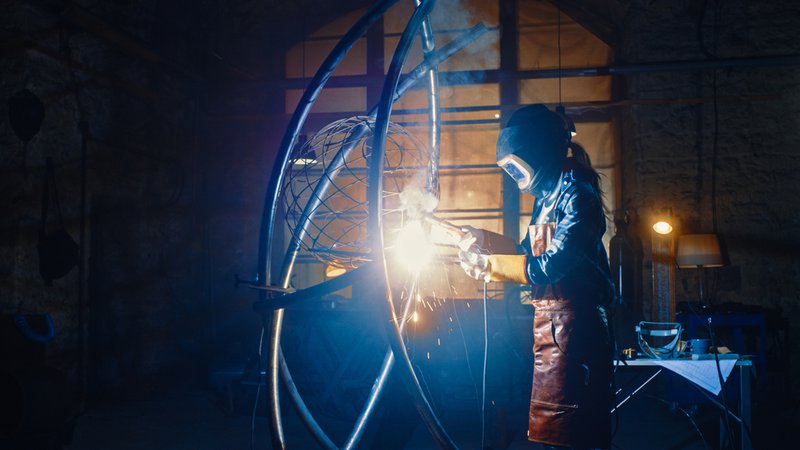
This is the part that surprises people who have never worked in fabrication. There is genuine creative input in this work. Custom clients are not ordering off a catalog. They describe what they need, and the fabricator helps figure out how to build it.
That problem-solving aspect becomes a source of real professional satisfaction for many welders in this environment. Some custom shops build artistic metalwork, architectural features, or motorsport components. Others serve industrial clients with highly precise, functional requirements. Either way, the welder is contributing something that did not exist before.
This does not mean every job is glamorous. There is still repetitive prep work, grinding, and cleanup. But the overall arc of a career in custom fabrication tends to offer more variety and ownership than many other welding environments.
What It Takes to Get Started
Working in a fabrication shop offers welders something that many other career paths do not: variety, creative input, and the chance to build things that do not exist until you make them. Custom fabrication shops serve clients across dozens of industries, requiring welders who are technically versatile and capable of thinking through unique challenges.
The foundational requirement is the same as any welding training path. You need to know how to weld well. Custom shops are not entry-level training environments. Shop owners expect incoming welders to arrive with a working understanding of core processes and the ability to pass a weld test.
That foundation comes from formal training. Structured programs that build hands-on welding skills across multiple processes give you the practical competence shops are looking for. The more time you spend in a booth learning to run clean, consistent welds on different materials, the more prepared you will be when an opportunity at a shop presents itself.
At Arclabs, the focus is on building that foundational skill set. More than 95% of program time is spent in practice, not theory. The goal is to make sure graduates are ready to step into real work environments, with the hands-on experience that shop owners actually value.
Contact Arclabs Welding School to learn about our welding programs, class schedules, and how we can help you develop the skills that industries are actively seeking. Visit us at arclabs.edu for all locations or call 877-647-4111 to speak with an admissions advisor about your welding education options.

