
When you first strike an arc, it’s easy to focus entirely on your machine settings, your hand speed, and keeping a steady puddle. But there’s a massive variable that completely changes how molten metal behaves: gravity. In a perfect world, every weld would be laid out flat on a comfortable workbench right in front of you. In the real world, however, pipes run vertically, overhead beams need securing, and structural joints twist in every imaginable direction. This is precisely why welding positions are so critical.
Understanding the standard welding positions isn’t just about learning industry jargon; it’s a fundamental skill that dictates how you manage your weld puddle, adjust your angles, and ensure a strong, defect-free joint.
In this beginner-friendly guide, we will break down the primary welding positions and give you practical tips to conquer gravity, no matter what angle the job throws at you.
Mastering the Flat Position: The Foundation of Training
The flat position, categorized as 1G or 1F, serves as the initial entry point for students. With the workpiece positioned horizontally, you execute the weld across the top side. In this orientation, gravity actually assists your technique.
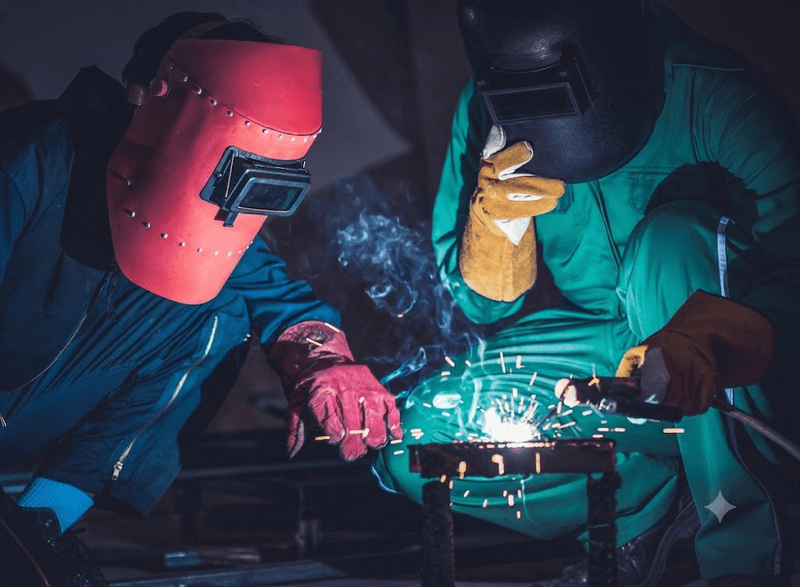
Since molten metal is naturally pulled into the joint in this orientation, you can manage the puddle more effectively to create a professional, clean bead. This ease of control is why the flat position is the standard starting point for welding students across most processes.
By building proficiency in this position first, you establish a strong technical foundation. It allows you to refine your torch angle and travel speed without the added struggle of resisting gravity, which prepares you for the more complex demands of out-of-position welding.
The Horizontal Position: Testing Your Skill Against Gravity
Entering the horizontal position (2G or 2F) marks your first real encounter with out-of-position welding. While the joint itself is horizontal, the vertical weld face introduces a new challenge: gravity constantly pulls the molten metal downward, causing it to sag. Successfully managing this requires a steady travel speed and precise adjustments to your travel angle.
This position is a common requirement in fabrication and structural projects. Although it demands more focus than flat welding, dedicated practice makes it a manageable and vital part of your toolkit.
Mastering the horizontal position is a significant turning point for any welder. It serves as a necessary bridge, moving you beyond foundational flat-work and preparing you for the technical complexities of overhead and vertical joints where gravity is a constant factor.
The Vertical Position: Up or Down
Vertical welding (3G or 3F) runs the weld along a vertical plane. You have two directions to work in:
- Vertical up: You travel from bottom to top. This is more common, especially on thicker base materials. The upward motion helps build a solid bead with good penetration.
- Vertical down: You travel from top to bottom. This works better on thinner materials, but it requires more discipline to avoid running ahead of the puddle.
Managing heat input and travel speed is critical in this position. Moving too slowly lets the molten pool build up. Moving too fast risks poor fusion. Vertical welding takes repetition to get right, but it's a skill you'll use throughout your career.
Overhead Welding: Conquering the Most Difficult Position
The overhead position (4G or 4F) is the most challenging orientation because the workpiece is situated above the welder. Working from beneath the joint means fighting gravity with every drop of molten metal, as the weld pool naturally attempts to sag or drip.
To prevent beads from crowning excessively, you must maintain a tight arc, utilize faster travel speeds, and exercise precise heat management. Success in this demanding position requires not only technical skill but also significant physical endurance and steady posture.

Mastering overhead welding requires more than just technical skill; it is a physical feat to maintain proper form while working against gravity. This specialized position is a milestone you work toward once your foundational techniques are firmly established.
The Importance of Positions Prior to Specialization
Grasping these four core positions is far more than a theoretical exercise. In the field, every welding project is defined by its environment; whether it is a pipeline buried deep underground or structural steel reaching high above, you must navigate diverse spatial realities. Since you cannot always control your orientation on-site, being prepared for any angle is essential.
Training emphasizes these positions because they are the building blocks of professional expertise. Mastering them allows a developing welder to cultivate:
- Advanced Puddle Awareness. Developing an intuition for how the weld pool reacts to varying gravitational forces.
- Precision Heat Managemen.: Learning to fine-tune settings based on position to prevent issues like cold lap or sagging.
- Refined Body Mechanics. Building the stamina and stability required to execute clean welds in confined or challenging spaces.
- Technical Consistency. Ensuring that every bead remains uniform and reliable, regardless of the joint's angle.
These core competencies serve as the bedrock for every advanced process you will encounter, including SMAW, GMAW, FCAW, and GTAW.
ArcLabs: Where Practice Builds Proficiency
Understanding the theory of welding positions is only the beginning; true mastery comes from repetitive, hands-on application. Arclabs welding programs are designed to immerse students in vertical, horizontal, overhead, and flat positions. We focus on building a resilient practical foundation that prepares you for the rigors of the field, rather than just meeting basic requirements.
In industries like energy, manufacturing, and construction, employers prioritize welders who can maintain a flawless bead overhead just as easily as they can in the flat position. This versatility is a key professional advantage.
ArcLabs San Antonio is our newest campus. With hands-on labs, experienced instructors, and a focus on real-world skill development, it’s ready to serve the next generation of welders in South Texas.
If you are ready to develop a solid command of the trade, view all our locations here, send us a message or call 877-647-4111 to speak with an admissions advisor about your training options.

