
In a hands-on industry where quality speaks louder than words, showcasing your welding work visually is the single best way to prove your skill to potential clients. Whether you specialize in precision TIG fabrication, structural repair, or custom metal art, a well-crafted portfolio transforms your past projects into your strongest sales tool. By presenting clear photos, technical details, and project highlights, you can bridge the gap between being just another contractor and becoming the go-to specialist clients trust.
The Value of a Welding Work Portfolio
Serving as tangible proof of your craftsmanship, a welding portfolio acts as a curated collection of your finest completed jobs. While these collections are commonly hosted online today via basic websites or social media profiles, a physical copy still holds value. Ultimately, the substance of your work matters far more than the delivery channel.

Its relevance varies across the industry. Large industrial positions and internal roles often prioritize practical, hands-on assessments over photographs. However, a portfolio is highly effective for freelance work, custom fabrication, repairs, and ornamental projects. Clients in these sectors depend heavily on visual confirmation, and establishing that visual trust can unlock opportunities that traditional applications cannot reach.
Presenting a clean gallery addresses critical, unspoken client inquiries regarding your neatness, your attention to detail, and your ability to handle their specific projects. Providing clear answers to these points successfully transforms you from an unknown applicant into a serious contender.
What Belongs in a Welding Work Portfolio
You do not need dozens of entries. You need the right ones. Quality carries far more weight than volume here. A handful of sharp, well-shot examples beats a cluttered gallery. Curate it like a highlight reel, not a scrapbook.
Aim to include:
- A range of processes. Cover several methods across MIG, TIG, and stick where you have them. Different tasks call for different approaches.
- Varied materials and thicknesses. Steel, aluminum, and stainless each behave in their own way. Proof across a few tells a buyer you adapt.
- Multiple positions. Flat beads are one thing. Vertical and overhead runs reveal real control.
- Completed projects, not lone samples. A finished gate, trailer fix, or handrail gives context.
- Tight close-ups. Let viewers study the bead. Consistency and clean starts speak volumes.
Reaching this kind of breadth starts with solid instruction. Well-structured welding training programs give you the practice across materials and methods that a portfolio later displays.
Documenting Your Welding Work Honestly
The way you showcase your welding projects directly influences a client's perception. Poor lighting can conceal your finest beads, while cluttered backgrounds distract from the work. Following a few fundamental steps can significantly enhance your presentation.
Consider these essential tips when photographing your work:
- Ensure proper lighting. Utilizing natural daylight or a strong overhead light highlights the actual quality of your weld.
- Clean the component beforehand. Remove all spatter, slag, and dirt prior to taking photos.
- Stabilize and zoom in. Ensure the joint fills the frame, as blurry images can appear unprofessional.
- Show the overall scale. Including a broad view of the completed project provides context for your close-up shots.
Integrity is just as critical as good photography. Display only the welds that you personally completed, and never claim credit for another person's craftsmanship. The welding community is tightly knit, and a reputation can be damaged instantly; a single dishonest photo could jeopardize future opportunities.
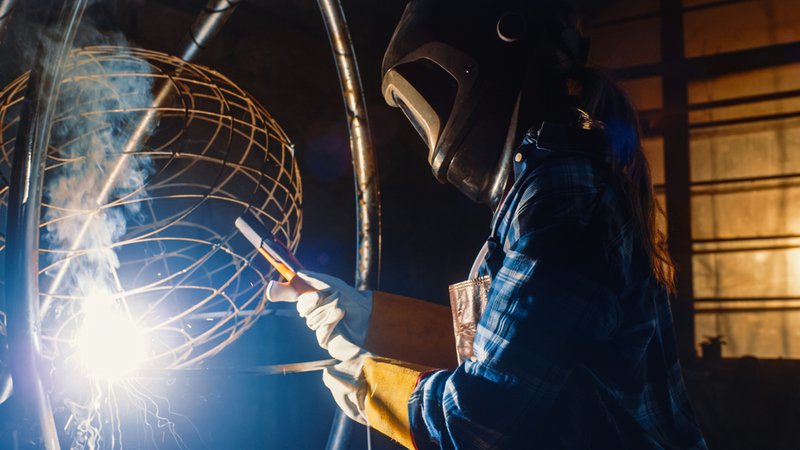
Providing the narrative behind each project is equally valuable. Explain the specific challenge, the alloy used, and your exact solution. A brief, straightforward description transforms a standard photograph into a demonstration of your problem-solving abilities. Developing this level of consistency requires ongoing dedication, which is best achieved through hands-on, guided practice.
Building the Foundation of a Standout Portfolio
A true portfolio relies entirely on genuine craftsmanship; no amount of creative photography can hide a weak weld. Long before a camera is ever used, the finest portfolios take shape right on the shop floor, one careful bead at a time.
At Arclabs, this foundational training is our core focus. Our programs are designed to instill the essential skills that form the basis of any future welding specialty. By spending the majority of their time at the bench, students run metal and hone their techniques side-by-side with experienced professionals, gaining a robust foundation to support whatever career path they select.
Professional mindset is equally critical, as consistently employed welders generally demonstrate key professional habits: they arrive punctually, demand precise results, and maintain an ongoing curiosity about unfamiliar techniques. These professional practices are clearly reflected in the final product, catching the attention of clients. Enrolling in a foundational welding education helps build these vital career instincts right alongside intensive hands-on technical practice.
Ready to Put Your Best Welds Forward?
Your portfolio can only display what your skills back up. If you want welding work worth photographing, honest training is the first step.
At Arclabs Welding School, our training programs are specifically engineered to deliver a comprehensive understanding of welding fundamentals, such as shop discipline, defect identification, and proper technique. Mastering the correct methods from day one ensures a solid professional footing that will support your success in the industry.
ArcLabs San Antonio is our newest campus. With hands-on labs, experienced instructors, and a focus on real-world skill development. If you are ready to develop a solid command of the trade, view all our locations here, send us a message or call 877-647-4111 to speak with an admissions advisor about your training options.

