
If you are learning aluminum welding, you quickly discover that this versatile metal behaves quite differently from steel. Aluminum offers an unbeatable strength-to-weight ratio and natural corrosion resistance, making it essential across aerospace, automotive, marine, and construction industries. However, those same unique physical properties create distinct challenges for welders who are accustomed to working with traditional ferrous metals.
Mastering aluminum welding requires a deep understanding of how the material reacts to heat and atmosphere. By learning how to overcome its thermal quirks and properly manage surface contamination, you can reliably produce strong, clean, structurally sound welds.
What Makes Aluminum Welding Different From Steel?
Welding steel gives you visual indicators and a forgiving thermal profile. Aluminum offers neither. To build confidence with the material, you must account for three critical metallurgical characteristics.
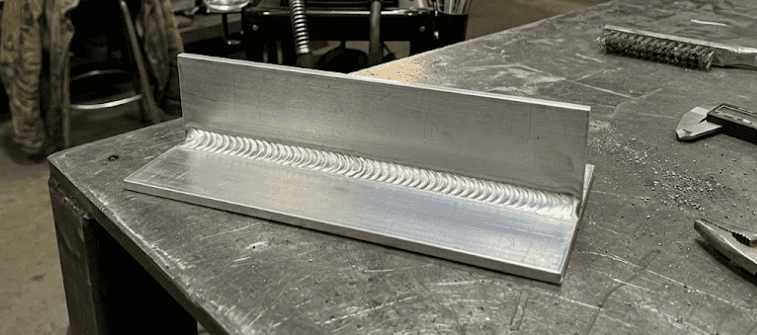
High Thermal Conductivity
Aluminum transfers heat away from the weld zone nearly four times faster than steel. When you strike an arc, the base metal absorbs and dissipates the thermal energy rapidly. This property requires higher initial heat input to establish a puddle. Once the surrounding workpiece heats up, however, that accumulated heat can cause the puddle to expand suddenly, increasing the risk of burning through the material.
Low Melting Point with No Visual Warning
Steel changes color as it absorbs heat, glowing bright orange and red before reaching its liquid state. Aluminum shows no visual signs of heating. It retains its silver color right up to its melting point of roughly 1,220°F (660°C). Without a visible signal, inexperienced welders can easily overheat the workpiece and cause structural collapse.
The Melting Point Conflict: Aluminum vs. Oxide
The most significant obstacle in aluminum welding is the microscopic layer of aluminum oxide (Al2O3) that forms instantly when the raw metal contacts oxygen. While raw aluminum melts at 1,220°F, its protective oxide skin melts at approximately 3,700°F (2,037°C).
If you attempt to strike an arc without removing this layer, you will burn through the underlying aluminum long before you melt the surface skin. The higher-melting oxide breaks up into solid particles that sink into your liquid weld pool, causing severe porosity, lack of fusion, and immediate structural failure.
Step-by-Step: Pre-Weld Oxide Removal and Cleaning
Proper surface preparation accounts for more than half the secret to successful aluminum welding. You cannot skip mechanical or chemical cleaning steps and expect a sound bead. Follow this deliberate cleaning sequence before striking your arc.
- Solvent Degreasing First. Always wipe down the material with acetone or a dedicated non-chlorinated solvent before using mechanical abrasives. Removing surface oils, grease, and shop grime prevents you from driving hydrocarbons deeper into the metal during brushing.
- Dedicated Stainless Steel Wire Brushing. Use a clean, stainless steel wire brush reserved exclusively for aluminum work. Using a brush that previously cleaned carbon steel deposits tiny iron particles into the aluminum joint, leading to immediate cross-contamination and localized corrosion.
- Proper Brushing Technique. Apply light, firm pressure and stroke the wire brush in a single direction. Scrubbing back and forth pushes loosened oxides back into the surface scratches rather than peeling them away.
- Machine-Assisted Oxide Removal. When using Alternating Current (AC) TIG processes, adjust your AC balance controls correctly. The electrode-positive (EP) half of the current cycle physically blasts away the remaining oxide layer through cathodic cleaning, while the electrode-negative (EN) portion provides deep penetration into the base metal.
Pro Tips for Consistent Aluminum Welds
Beyond surface preparation, managing your equipment setup and workplace environment ensures predictable results across every joint.
- Control Moisture and Storage. Store aluminum plates and filler rods inside a clean, dry area with stable ambient temperatures. High humidity creates hydrated oxides on the metal surface, which release hydrogen into the weld pool and cause internal porosity.
- Optimize Wire Feeding Setup. Soft aluminum wire bends easily inside MIG torch liners. Use a specialized push-pull gun or a dedicated spool gun to maintain smooth, continuous wire feeding without tangles or bird-nesting**.
- Verify Shielding Gas Purity. Always use 100% pure Argon or an Argon-Helium blend to protect the reactive molten puddle from atmospheric oxygen. Check torch seals, gas hoses, and flow rates to prevent air leaks from pulling moisture into the gas stream.
Where Theory Meets the Torch
Understanding the fundamentals of aluminum welding demands patience, technical precision, and hands-on practice. While advanced applications require specialized certifications down the line, every skilled tradesperson starts by mastering core metal properties, torch control, joint design, and material preparation.
Foundational skill development is the cornerstone of the programs at Arclabs Welding School. Within the welding booth, students engage in extensive hands-on training to master essential variables, including electrode angle, travel speed, and arc length, across a variety of processes.
The instructors at Arclabs do more than provide theoretical explanations; they actively collaborate with students in the shop. This side-by-side approach allows students to physically feel and visually identify the characteristics of successful versus failing welds. This type of immediate, professional feedback is critical for cultivating long-term proficiency.
If you are ready to develop a solid command of the trade, view all our locations here, send us a message, or call 877-647-4111 to speak with an admissions advisor about your training options.
Frequently Asked Questions
**What is bird-nesting in welding?
Bird nesting is a wire feeding malfunction in wire-feed welding (such as MIG or flux-cored welding) where the filler wire bunches up, tangles, and jams inside the drive-roll mechanism or drive housing, forming a messy knot that resembles a bird's nest.
Does aluminum require preheating before welding?
Heavy sections often require preheating, maintained under 250 °F. Avoiding excessive heat prevents structural degradation in heat-treatable alloys.
What causes cracking at the end of an aluminum weld bead?
Crater cracking results from sudden arc termination. Utilizing a downslope function, a crater fill setting, or tapering foot pedal current prevents this issue.
When should you use 4043 versus 5356 aluminum filler metal?
Alloy 4043 offers excellent fluidity and crack resistance for castings, while alloy 5356 delivers higher tensile strength and responds better to anodizing. The base material dictates the appropriate filler selection.
Is it possible to weld aluminum outdoors?
Outdoor drafts disrupt argon shielding gas coverage. Establishing wind barriers or moving operations indoors ensures weld integrity.

