
In heavy industrial fabrication, a weld can look smooth on the surface while masking structural flaws that lead to catastrophic failure. These hidden defects create bad welds that fail non-destructive testing, waste expensive materials, and compromise worker safety.
Among the most common defects encountered in heavy-plate metal inert gas (MIG) welding are cold lap and lack of fusion. While both flaws degrade structural integrity, welders can systematically eliminate them by mastering machine parameters, joint preparation, and puddle manipulation.
Understanding Cold Lap vs. Lack of Fusion
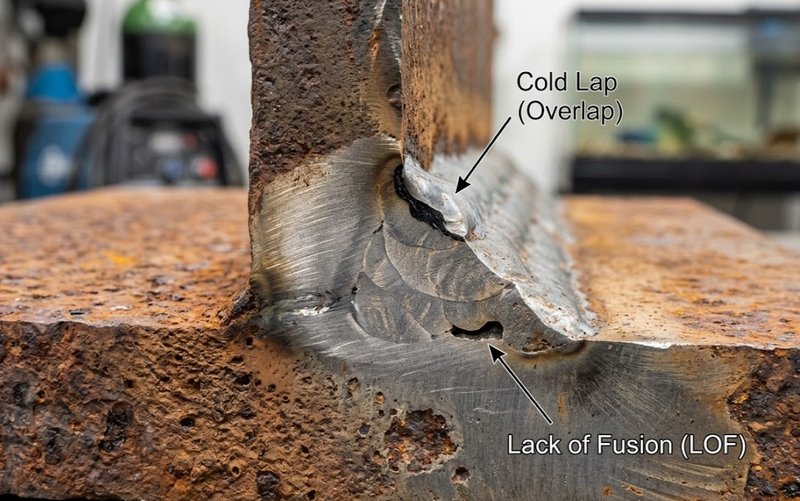
Recognizing the distinction between cold lap and lack of fusion helps welders troubleshoot defects on the shop floor.
- Cold Lap (Cold Overlap. This occurs when molten filler metal flows over unmelted base metal without creating a true metallurgical bond. The weld metal simply rests on top of the plate, creating a sharp notch along the toe of the weld.
- Lack of Fusion (LOF). This discontinuity happens when the filler metal fails to fuse with the side walls of the joint or with preceding weld passes in multi-pass applications.
Heavy steel plates act as heat sinks, drawing thermal energy away from the weld zone. When heat dissipates faster than the arc delivers it, fusion suffers.
Primary Causes of Fusion Defects in MIG Welding
Welders usually encounter cold lap and lack of fusion when they misjudge the relationship between heat input, wire feed speed, and torch positioning.
1. Inadequate Heat Input
Using voltage and amperage settings intended for thinner materials on heavy plates results in shallow penetration. The arc melts the wire faster than it heats the base metal, causing filler metal to pool on cold steel.
2. Incorrect Transfer Mode
Short-circuit transfer (GMAW-S) works well for thin sheet metal and root passes, but it lacks the thermal energy required to penetrate thick plates. Attempting heavy structural welds in short-circuit mode frequently causes bad welds characterized by severe sidewall cold lap.
3. Improper Gun Angle and Travel Speed
Directing the arc toward the front of the puddle rather than the leading edge of the base metal allows molten metal to roll ahead of the arc. Once the puddle outruns the arc, the arc cannot melt the underlying base metal, leaving unfused sections behind.
4. Surface Contamination
Heavy structural steel carries mill scale, rust, oil, and moisture. These contaminants act as thermal barriers and introduce oxides that prevent the filler metal from wetting out evenly against the joint walls.
Key Strategies to Prevent Cold Lap and Lack of Fusion
Eliminating fusion defects requires a disciplined approach to machine setup and torch control before strike-up.
- Switch to High-Energy Transfer Modes. Use spray transfer or pulsed-MIG when joining plates thicker than 1/4 inch. Spray transfer uses higher voltages and wire speeds to create a steady stream of tiny molten droplets, providing the heat input necessary for deep penetration.
- Maintain the Arc on the Leading Edge. Keep the electrode pointing at the front boundary of the weld pool. The arc must continually melt the base plate before the molten puddle covers it.
- Optimize Torch Angles. Use a push angle of 10 to 15 degrees. Pushing the torch directs shielding gas and arc force straight into the root, helping the puddle wet into the sidewalls cleanly.
- Clean the Base Metal Thoroughly. Grind away all mill scale, rust, and paint at least one inch back from the joint edge. A shiny, clean steel surface allows proper wetting action and reduces the risk of inclusion defects.
- Adjust Multi-Pass Joint Designs. Ensure bevel angles provide adequate access for the gun nozzle. Narrow joint angles starve the root of heat because the arc jumps to the nearest sidewall instead of penetrating the bottom.
Common Myths About Heavy MIG Welding
| Myth | Reality |
|---|---|
| “A larger weld bead always means a stronger joint.” | Excessively large weld beads often mask internal cold lap caused by a slow travel speed. |
| “Grinding surface scale is optional if you turn up the voltage.” | Mill scale raises the melting temperature of the surface, causing bad welds regardless of machine settings. |
| “Short-circuit MIG works for any metal thickness.” | Short-circuit transfer lacks the continuous heat input needed for heavy structural joints. |
Turn Understanding Into Precision
Avoiding structural defects takes more than reading machine charts. Welders need hands-on shop experience to read the puddle, recognize improper wetting in real time, and correct torch angles on the fly.
Learning to spot and correct bad welds early in training saves time, reduces material waste, and builds the technical discipline required across the metal fabrication sector. Formal entry-level education focuses on teaching these foundational principles: machine setup, joint prep, positioning, and safety.

A strong foundation in base welding processes gives students the practical confidence needed to handle heavy-plate applications, prepare for entry-level shop positions, or later pursue advanced certifications in specialized field roles.
Arclabs Welding School provides hands-on, instructor-led courses designed to build practical shop skills from the ground up. We offer flexible day and night classes at our campuses in South Carolina and Texas. Our instructors do more than provide theoretical explanations; they actively collaborate with students in the shop.
By working side-by-side with experienced instructors, students gain hands-on experience in recognizing and tactilely assessing proper weld quality. This real-time, professional guidance plays a vital role in building lasting technical skills.
If you want to master the core skills of this industry, view all our locations here, send us a message, or call 877-647-4111 to speak with an admissions advisor about your training options.

