
Selecting the right weld joint design is one of the most critical decisions a welder makes before striking an arc. A properly chosen butt joint or tee configuration ensures structural integrity, proper load distribution, and efficient material usage across any fabrication project. Behind every reliable bridge, pipeline, and structural frame is a clear understanding of joint geometry and metal preparation.
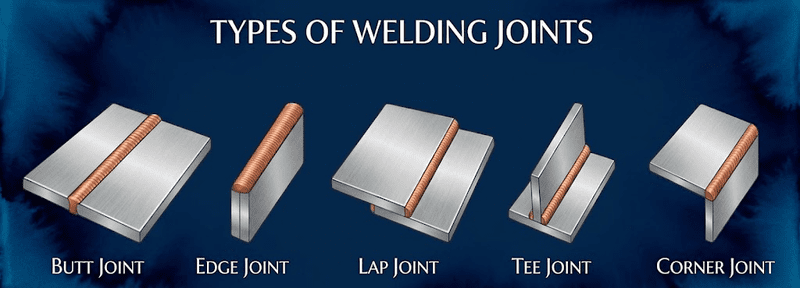
This guide breaks down the five basic American Welding Society (AWS) joint types, highlighting where each excels and how to select the right fit for your work.
Spotlight on the Butt Joint: The Foundation of Structural Welding
The butt joint is the workhorse of code-quality fabrication. It is formed when two pieces of metal are aligned end-to-end in the same plane, creating a continuous surface once joined. Because the load passes directly through the weld seam, a correctly fabricated butt joint provides exceptional strength under tension and compression.
Achieving high-strength performance requires understanding edge preparation based on material thickness:
- Square Butt Joint. Suitable for thin material under 3/16 inch thick. The straight edges butt directly together with a small root opening.
- Single V-Groove. Essential for materials between 3/16 inch and 1/2 inch thick. Beveling the edges allows the arc to penetrate fully to the root.
- Double V-Groove. Used on heavy plates over 1/2 inch thick. Beveling both sides reduces the total amount of weld metal needed and helps control heat distortion.
- U-Groove and J-Groove. Applied on extra-thick materials where a rounded root reduces fill volume and joint stress.
While a butt joint delivers superior strength, it demands precise fit-up. Improper root openings or incorrect bevel angles lead to incomplete penetration, burn-through, or internal voids that cause structural failure under load.
Butt joints are most commonly used in high-integrity applications such as pressure vessels, cross-country pipelines, structural steel frameworks, and shipbuilding where continuous, full-penetration welds are required to withstand heavy dynamic loads. However, the other four joint types are equally vital when specific geometries or assembly constraints arise.
Tee and lap joints excel at transferring shear loads in framed structures and sheet metal assemblies, while corner and edge joints provide the necessary configurations for constructing sealed enclosures, tanks, and flanged components without demanding extensive edge preparation.
Comparing the Other 4 Basic Weld Joints
The following four alternative configurations offer unique advantages for specific structural and assembly requirements.
1. Tee Joint (T-Joint)
A tee joint joins two components at a 90-degree angle, forming a "T" shape. Welders typically secure this joint using fillet welds on one or both sides. Tee joints offer excellent shear strength, making them standard in structural steel framing, equipment bases, and stiffener attachments. However, thick components subjected to high tensile loads may require beveling to allow groove welds for added strength.
2. Lap Joint
A lap joint consists of two overlapping pieces of metal laid flat against each other. Fillet welds are placed along the exposed edges. Lap joints offer forgiving fit-up tolerances because slight misalignment does not ruin the joint fit. Fabricators often use lap joints for sheet metal assemblies, patch repairs, and non-structural reinforcements.
3. Corner Joint
Corner joints meet at a 90-degree angle at their edges to form an "L" shape. Welders use two main styles:
- Open Corner Joint: Leaves a gap at the outer corner, allowing full-penetration welding for pressure vessels and fluid tanks.
- Closed Corner Joint: Places the edges flush, creating a clean outer edge suitable for sheet metal boxes, machinery guards, and architectural enclosures.
4. Edge Joint
An edge joint places two parallel or nearly parallel surfaces flush together, uniting them along a shared top edge. Since this joint offers limited depth of penetration, it handles lower structural loads. Fabricators rely on edge joints for sheet metal flanges, muffler casings, and temporary fit-ups before final assembly.
Quick Comparison Matrix
| Joint Type | Primary Stress Type | Edge Prep Needed? | Common Weld Type | Typical Application |
|---|---|---|---|---|
| Butt Joint | Tension & Compression | Yes (for thick metals) | Groove Weld | Piping, structural plates, pressure vessels |
| Tee Joint | Shear & Longitudinal Tension | Minimal | Fillet Weld | Beams, frames, structural supports |
| Lap Joint | Shear | No | Fillet Weld | Sheet metal, lap splices, repairs |
| Corner Joint | Bending & Tension | Optional | Fillet or Groove | Tanks, enclosures, sheet metal boxes |
| Edge Joint | Low-Stress Shear | No | Edge / Groove Weld | Sheet metal edges, flanges, light covers |
Key Factors in Selecting the Right Joint Design
Choosing the correct joint geometry requires balancing structural demands against practical shop conditions. Before cutting or tacking material, consider these core factors:
- Base Metal Thickness. Thin sheet metal works well with square edges and lap joints, whereas thick plate requires beveled grooves to achieve sound penetration.
- Load Orientation. Determine whether the assembly will face direct tension, shear forces, bending moments, or dynamic vibration.
- Access and Position. Ensure the torch or electrode can maintain the correct angle throughout the joint length.
- Fabrication Cost. Minimize unnecessary beveling and joint prep time to control labor hours without sacrificing quality.
Build Your Foundation in Welding at Arclabs
Understanding weld joint geometry is the first step toward producing sound, code-quality welds. Before you can pursue specialized certifications or advanced pipe welding roles, you must build a solid core of practical skills.
At Arclabs Welding School, our training programs focus on hands-on instruction in standard welding processes, print reading, joint preparation, and shop safety. We give you the structured environment and real-world booth time needed to master fundamental joint designs, weld placement, and puddle control.
Ready to start your journey in the trade? Explore our core welding programs at Arclabs Welding School and build the base skills you need for a career in fabrication. View all our locations here, send us a message or call 877-647-4111

