
Every time a welder strikes an arc, they step into a dynamic dance of physics, metallurgy, and pure muscle memory. Behind every flawless bead lies a masterclass in the "Big Three" of manual welding: travel speed, torch angle, and arc length. These variables are completely under the operator's control. Altering just one by a fraction of an inch or a couple of degrees can mean the difference between a textbook, high-strength joint and a failed inspection riddled with porosity, undercut, or lack of fusion.
Whether you are laying down a root pass on heavy pipe or stitching together thin sheet metal, understanding how these three factors interact, and learning how to read the puddle to adjust them on the fly, is what separates a novice from a master craftsman.
Understanding Arc Length in Welding
The distance between your base metal surface and the tip of the electrode is known as arc length. This variable is critical because it dictates fusion quality, bead profile, and heat input. Maintaining the correct distance is a skill that requires significant booth time to master, as the primary challenge lies in keeping that gap consistent while in motion.
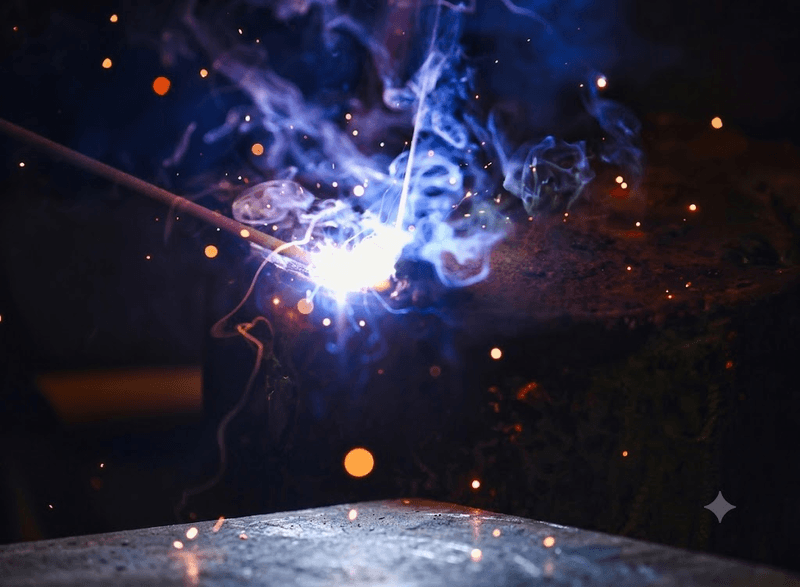
To establish a baseline, aim for an arc length roughly equivalent to the diameter of the electrode's core. You can also use your ears to gauge accuracy: a steady, crackling sound typically indicates you are in the ideal range, whereas irregular sputtering often means the distance needs adjustment.
Improper arc length leads to several specific weld defects:
- Long Arc: Results in more spatter, flatter beads, and shallower penetration. It also allows atmospheric gases to contaminate the weld pool, causing porosity.
- Short Arc: Focuses the heat for better fusion and enhanced puddle control, but going too short can cause the electrode to stub out and creates heavy spatter.
Travel Speed and What It Does to Your Weld
Travel speed is the rate at which you move the electrode along the joint. It directly affects bead width, penetration depth, and overall heat input. Move too fast, and the bead narrows with poor fusion at the root. Move too slow, and the puddle grows too large, risking burn-through or slag entrapment.
There is no single correct speed. It varies with the process, the material thickness, the joint type, and the position. What stays constant is this: the puddle tells you everything. Learn to read it, and you can self-correct as you go.
Steady travel speed is one of the harder basics to develop. New welders often vary their pace without realizing it. Width inconsistencies, irregular edges, and uneven penetration all trace back to speed problems.
Electrode Angle and Weld Direction
The positioning of the electrode is defined by two primary metrics: the work angle and the travel angle. The work angle describes the electrode's tilt in relation to the weld joint, while the travel angle refers to its forward or backward inclination along the path of the weld.
Proper work angle is essential for focusing arc energy directly into the joint; any deviation can displace the arc, resulting in asymmetrical fusion or undercutting. Meanwhile, the travel angle determines the technique used to manage the weld puddle, either pushing or pulling.
Pulling, or dragging, the electrode generally provides deeper penetration and superior visibility of the puddle. Conversely, pushing the electrode sends heat in front of the arc, typically yielding a flatter and broader bead. Selecting the appropriate method usually depends on the specific joint configuration and welding process.
Finished welds are highly sensitive to even minor shifts in these angles. Just a few degrees of error can lead to poor edge tie-in or undercut at the toes. Ultimately, mastering angle control is a matter of consistent physical practice rather than theoretical study.
How the Arc Length and Other Variables Work Together
These variables do not operate independently. Adjusting one always shifts the dynamic of the others. Slow your travel speed, and you need to adjust your arc length to avoid overheating the puddle. Change your electrode angle, and the bead profile shifts in a way that may require a speed correction.
Welding variables are deeply interconnected; modifying one inevitably impacts the others. For example, reducing travel speed requires a corresponding adjustment in arc length to prevent the puddle from overheating. Similarly, shifting the electrode angle alters the bead profile, often necessitating a change in speed to maintain quality.

This interdependence is why welding is fundamentally a hands-on trade. While theory provides a foundation, it is hands-on practice that develops the intuition needed for real-time adjustments.
True mastery of these fundamentals is rarely achieved through casual observation on a job site. It demands structured, repetitive practice and critical evaluations from experienced instructors. Developing a consistent command of these variables is the essential first step toward professional expertise.
Developing Foundational Welding Skills
Foundational skill development is the cornerstone of the programs at Arclabs. Within the welding booth, students engage in extensive hands-on training to master essential variables, including electrode angle, travel speed, and arc length, across a variety of processes. Establishing this core competency is what paves the way for advanced specialization once the initial training phase is complete.
The instructors at Arclabs do more than provide theoretical explanations; they actively collaborate with students in the shop. This side-by-side approach allows students to physically feel and visually identify the characteristics of successful versus failing welds. This type of immediate, professional feedback is critical for cultivating long-term proficiency.
ArcLabs San Antonio is our newest campus. With hands-on labs, experienced instructors, and a focus on real-world skill development, it’s ready to serve the next generation of welders in South Texas.
If you are ready to develop a solid command of the trade, view all our locations here, send us a message or call 877-647-4111 to speak with an admissions advisor about your training options.

