
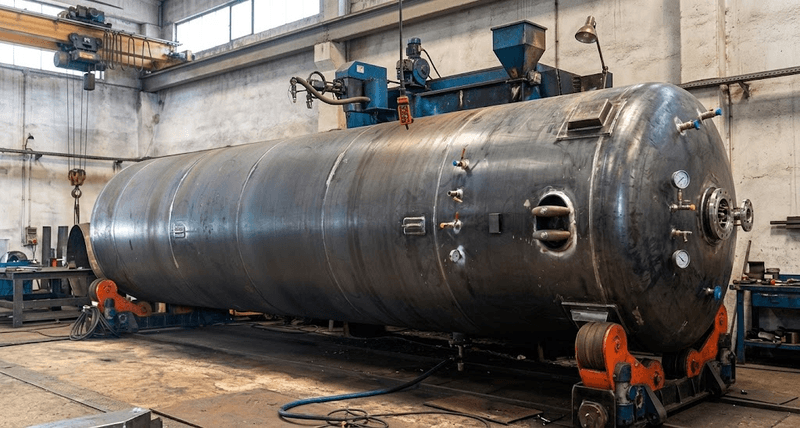
Understanding the fundamentals of boiler welding is critical for anyone looking to transition from standard structural work into specialized high-pressure fabrication. Modern industrial facilities rely heavily on sealed vessels, power boilers, and pressurized steam lines. When metal components hold thousands of pounds of pressure per square inch, the margin for error drops to zero.
Operating Conditions and Safety Standards
Pressure vessels and boiler tubes operate under punishing physical environments. Superheated steam, intense vibration, chemical exposure, and rapid thermal cycling put continuous strain on every joint. A microscopic pinhole, internal slag inclusion, or undercut seam can compromise structural integrity, leading to costly plant downtime or sudden mechanical failure.

To maintain safety across power generation, petrochemical processing, and heavy manufacturing, regulatory bodies set strict standards:
- ASME Code Compliance. Section IX of the American Society of Mechanical Engineers (ASME) Boiler and Pressure Vessel Code outlines qualifying procedures for welds exposed to internal pressure.
- AWS Standards. American Welding Society guidelines (such as AWS D10.12) govern pipe and tubing practices to ensure uniform structural integrity.
- Zero-Defect Quality Controls. Unlike standard structural frames where small cosmetic variations might pass inspection, pressure-rated joints must meet strict internal quality thresholds.
Core Processes for High-Pressure Joining
Selecting the right process depends on metal thickness, joint access, and field conditions. Tradespeople working on pressure-rated systems rely on specific arc processes to establish durable seals.
Mastering boiler welding requires a deep understanding of process selection:
- Gas Tungsten Arc Welding (GTAW / TIG): TIG is the preferred method for root passes on small-diameter boiler tubes and open-root joints. It allows precise control over heat input and weld pool behavior, preventing burn-through while creating smooth internal profiles without dross. Argon backing gas (purging) is frequently applied to prevent back-side oxidation.
- Shielded Metal Arc Welding (SMAW / Stick): Stick welding remains a primary choice for fill and cap passes on heavy-wall vessels and field repair operations. Low-hydrogen electrodes, such as E7018, provide high tensile strength and crack resistance when deposited correctly.
- Gas Metal Arc & Flux-Cored Arc Welding (GMAW/FCAW): Used frequently in shop fabrication settings, these continuous wire processes deliver high deposition rates on thick vessel shells while maintaining solid mechanical properties.
Physical Requirements and Spatial Execution
Working in power plants or manufacturing facilities presents unique physical hurdles. Tubing assemblies are often packed tightly together, leaving minimal room to position hands, torches, or view angles.
Success in field-level boiler welding hinges on physical dexterity and adaptability:
- Fixed Position Execution. Welders routinely work in fixed horizontal (5G) or 45-degree angled (6G) orientations. These setups force continuous adjustments in torch angle, rod angle, and travel speed as the weld progresses around the pipe circumference.
- Mirror Work. When a boiler tube sits inches from an adjacent wall, direct sightlines are impossible. Welders often learn to guide their torch while looking exclusively at the joint's reflection in a small inspection mirror.
- Thermal Control. Managing pre-heat temperatures and post-weld heat treatment (PWHT) ensures chrome-moly or alloy steels cool at controlled rates, preventing brittle grain structures from forming in the heat-affected zone.
Non-Destructive Examination and Qualification
Before a vessel or steam line enters service, welds undergo rigorous Non-Destructive Examination (NDE) to verify internal soundness without damaging the part:
- Radiographic Testing (RT): Industrial X-rays expose internal voids, lack of penetration, or trapped slag deep within the weld metal.
- Ultrasonic Testing (UT): High-frequency sound waves map internal discontinuities across thick metal sections.
- Surface Methods: Liquid Penetrant Testing (PT) and Magnetic Particle Testing (MT) reveal fine surface cracks along joint boundaries.
Passing a standardized test, such as an open-root pipe test in the 6G position, demonstrates that a welder has developed the physical control and technical awareness required for high-stakes industrial work.
Building a Career in the Trades
Completing high-pressure boiler welding applications demands disciplined practice, patience, and a thorough understanding of metal behavior under heat. The trade offers practical career paths for those who take pride in precision craftsman techniques and enjoy solving real-world mechanical problems.
While advanced code welding requires years of field experience and specialized certifications, every skilled craftsperson starts by learning core fundamental techniques. Building proper torch control, understanding puddle dynamics, and learning safe shop practices establish the groundwork for long-term growth in industrial fabrication.
Learn the Trades with Arclabs Welding School
High-stakes welding begins with a solid foundation. At Arclabs Welding School, we focus on real-world hands-on training to help you master fundamental welding processes. Our structured programs cover SMAW, GMAW, FCAW, and GTAW techniques, preparing students with the practical skills needed to launch an entry-level welding career. View all our campus locations here, send us a message, or call 877-647-4111 to speak directly with an admissions advisor about your training options.
Frequently Asked Questions
How does boiler welding differ from structural welding?
Structural welding joins beams and columns that carry external physical loads, whereas pressure equipment must contain volatile internal forces. Since failure risks are high, boiler tube welding requires strict adherence to wall thickness rules, complex alloy control, and absolute internal soundness.
What is post-weld heat treatment and why is it used?
Thick sections and alloy steels accumulate severe residual stress as they cool. Post-weld heat treatment involves controlled reheating to relieve that stress, soften hard microstructures, and restore toughness. Structural codes specify exact temperature ramps, hold times, and cooling rates for each material grade.
Is boiler and pressure vessel welding seasonal work?
Much of this work follows industrial shutdown schedules. Power plants and refineries typically schedule major outages during spring and fall when production demand drops. While many specialized welders travel to meet these turnaround windows, others maintain steady local shop or plant maintenance positions between outages.
What specific safety hazards are involved in boiler and pressure vessel welding?
Workers frequently operate in confined spaces, on elevated scaffolding, and around heavy residual heat, making strict safety protocols mandatory. Job sites rely on rigorous lockout/tagout procedures, continuous gas monitoring, hot work permits, and dedicated fire watches to mitigate these risks.

