
Joining stainless steel to carbon steel is one of the more challenging applications in metal welding. These two distinct alloys appear side by side across countless industrial piping networks, storage tanks, and structural fabrications, yet they respond differently to heat.
Austenitic stainless steel expands significantly and retains heat near the joint, while carbon steel transfers heat away rapidly and can harden near the fusion line. Choosing the wrong filler alloy or mismanaging heat input can produce a weld that passes an initial visual inspection only to fracture under operational stress weeks later. Mastering this joint requires a clear understanding of metallurgy, dilution control, and proper technique.
Thermal Mismatch and Microstructure Risks
The primary difficulty in this style of metal welding comes from incompatible physical and thermal properties. Austenitic stainless steels (typically 300-series) expand roughly 50% more than carbon steel when exposed to identical temperatures. Stainless steel also exhibits lower thermal conductivity, holding heat localized to the weld zone, whereas carbon steel conducts heat away quickly.
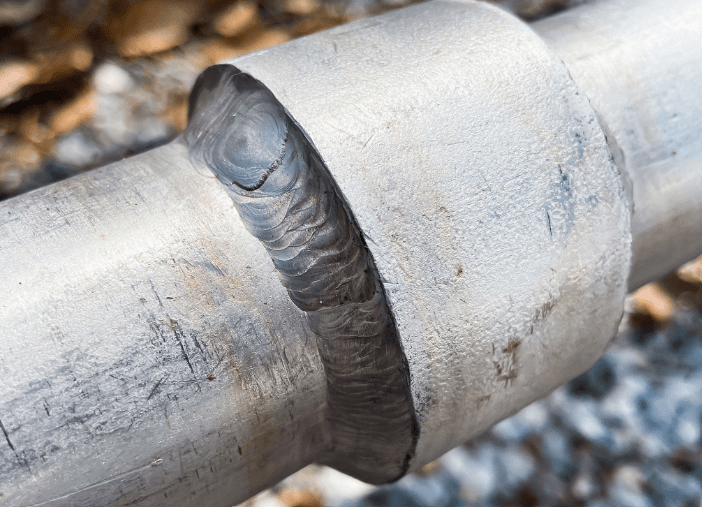
As the molten pool cools, this physical variance creates severe internal residual stress. The stainless side contracts sharply, pulling against the more rigid carbon side. Simultaneously, rapid heat dissipation on the carbon steel side can transform the heat-affected zone (HAZ) into martensite, a hard and brittle crystalline structure. When atomic hydrogen becomes trapped in this hardened zone, delayed cold cracking often occurs hours or days after the joint has cooled.
Filler Metal Selection: The Case for 309L
Selecting an appropriate consumable is critical when executing a dissimilar metal welding project. Standard stainless wire, such as 308L, lacks sufficient alloy content to accommodate iron dilution from the carbon steel base material. Standard consumables drop below required chromium and nickel levels, producing a brittle deposit prone to hot cracking.
Over-alloyed filler metals like ER309L or E309L solve this issue. Formulated with higher percentages of chromium and nickel, 309L compensates for iron pickup while maintaining a ductile, austenitic structure containing a small, controlled amount of delta ferrite. Delta ferrite acts as a buffer against solidification cracking.
A filler for needs to do several things at once:
- Hold enough alloy content to absorb iron dilution without turning brittle
- Maintain 3% to 10% delta ferrite content to guard against hot cracking
- Retain high ductility to absorb stress generated by unequal thermal contraction
- Match the thermal expansion requirements and operating temperatures of the assembly
For high-temperature applications subjected to thermal cycling, nickel-based fillers like ERNiCr-3 (Inconel 82) are often chosen. Nickel alloys feature a coefficient of thermal expansion positioned between carbon steel and stainless steel, reducing stress spikes at the interface.
Managing Dilution and Arc Technique
Dilution refers to the percentage of base metal melted into the weld pool relative to the filler metal added. In standard arc processes, dilution typically ranges between 20% and 40%. Excessive penetration into the carbon steel side dilutes the chemistry of the weld metal, pushing the deposit outside its intended metallurgical boundary.
Controlling dilution relies on precise torch manipulation and parameter management during metal welding:
- Amperage Control: Use the lowest functional heat input to restrict penetration on the carbon steel side.
- Travel Technique: Direct the arc primarily toward the stainless steel base metal, allowing the puddle to gently tie into the carbon steel.
- Pass Geometry: Stringer beads are preferred over wide weave passes to minimize heat buildup and pool turbulence.
- Butter Technique: Apply a thin layer of 309L filler directly to the carbon steel face prior to final fit-up. This "buttering" step creates a protective barrier that stabilizes chemistry before completing the main joint passes.

Practical Heat Control
Managing interpass temperatures protects the heat-affected zone from embrittlement. Preheat should be applied to thicker carbon steel sections to slow down the cooling rate, preventing martensite formation. Conversely, interpass temperatures on the stainless side should generally remain below 300°F (150°C) to avoid carbide precipitation and loss of corrosion resistance.
Tightly fitted joints, balanced welding sequences around the neutral axis, and multiple small pass layers help manage overall distortion while keeping the finished assembly within tolerance.
Build Your Foundation at Arclabs
Advanced operations like joining dissimilar alloys require more than theoretical knowledge. Success in the field depends on consistent torch control, an understanding of thermal behavior, and a strong grasp of shop safety.
At Arclabs Welding School, our hands-on training programs focus on establishing the fundamental metal welding skills across SMAW, GMAW, GTAW, and FCAW processes. Before specializing in complex industrial metallurgy, you need a solid foundation built on bench time, proper technique, and real-world instruction.
Ready to start building your career in the welding industry? Connect with us online or call 877-647-4111 to speak with an admissions representative today.
Frequently Asked Questions
Can gas metal arc welding (GMAW) be used for stainless to carbon steel joints?
Yes. Spray transfer with a 309L wire works well on heavier sections. Shielding gas selection affects both bead profile and alloy recovery, so match it to the wire manufacturer's guidance.
Do dissimilar metal welds resist corrosion like solid stainless steel?
No. The carbon steel side and the fusion boundary remain vulnerable. Assemblies exposed to moisture usually need a protective coating on that half.
What causes carbon migration in dissimilar metal welding?
Carbon moves from the plain steel into the stainless deposit during long exposure to elevated temperatures. Over years of service, this creates a soft band on one side and a hardened zone on the other.

